


LEARN ABOUT COCKTAILS
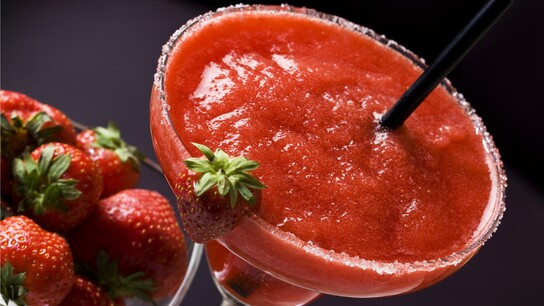
Many people associate the word Daiquiri with slushy drinks like the Strawberry Daiquiri, but the drink is about so much more. The classic version is made with light, pale rum, lime and sugar, and it is this version and other less slushy variations that have inspired writers like Ernest Hemingway and perhaps cooled John F. Kennedy during the Cuban Missile Crisis.
There are many preparation methods: Sometimes the ingredients are shaken with ice and served neat or with ice; other times they are blended together and served directly with slush.
Regardless of the preparation method, this light, sweet and sour and elegant drink has paved the way for a number of variations, including the now popular Frozen Strawberry Daiquiri. But the road to getting there is full of other exciting options.
History
Unlike many other cocktails, the history of the Daiquiri is well documented. The drink has its origins in Cuba near the village of Daiquiri in the late 1800s. After Roosevelt won the decisive battle of Santiago de Cuba in the Spanish-American War in 1898, it paved the way for American iron mining in Cuba. One of the leaders of the exploration of iron possibilities was Jennings Cox, and it was during his work near the village of Daiquiri that Cox came up with the idea for the drink. In short, he took what Cuba had to offer, light rum, sugar from sugar cane and lime juice, and shook it together. He did add a little soda water and poured the ice from the shaker into the glass, but that's how the Daiquiri was born. The cold, fresh drink worked perfectly as something to cool down with in the tropical heat of Cuba and was soon on bar menus in Havana.
As the drink spread, a number of variations also emerged. The Frozen Daiquiri was made famous by Constantino Ribalagua Vert at La Florida (now Floridita) in Havana, who eventually made at least 12 different frozen versions, although these were indeed filtered to prevent larger ice particles from being included. The drink was liked by, among others, Ernest Hemingway, but he preferred it without sugar and with twice the amount of rum. He was so fond of the drink that he mentioned it in the book ‘Islands in the Stream’ and had a separate variant named after him: Hemingway Special Daiquiri or Papa Doble (Hemingway was often known simply as Papa in Cuba). The drink and its countless variations eventually spread around the world and famous personalities such as John F. Kennedy named it their favourite aperitif, despite his tense relationship with Cuba.
Classic Daiquiri
- 5 cl rum
- Juice of one lime
- A dash of sugar
Shake vigorously with ice and serve without ice in a chilled Martini glass.
How to make a perfect Daiquiri?
With so many variations, there is a lot to consider when making a Daiquiri. Below you will find some tips.
Which rum?
This is one of the easiest things to deal with. When choosing a rum for your Daiquiri, it should be a light, white rum. Latin American rums, especially Cuban, are known for having this character. Daiquiris are all about lightness, elegance, and subtlety; a stronger rum can also be good, but then the drink is not a Daiquiri in the traditional sense of the word.
Sugar or sugar syrup?
Although the drink was originally made with sugar, it is much easier to use sugar syrup. Sugar is difficult to dissolve in cold solutions and alcohol. You can easily make sugar syrup by melting 2/3 sugar in 1/3 water.
Sugar or sugar syrup, it is most correct to use sugar from sugar cane, not beets, in line with what Cox used in Cuba.
Water?
Cox added soda water to the original Daiquiri. As a rule of thumb, this is not necessary when making Daiquiris with sugar syrup (which contains water) or a lot of ice (since ice gives off water).
Which method?
Daiquiris can be served in a variety of ways. As a rule of thumb, versions served without ice will be the strongest, while those served with ice will be the mildest and most refreshing. If the ice is crushed or powdered, this makes the drink all the milder and more refreshing.
- Bare: The drink is shaken with ice and served without ice.
- With ice: The drink is shaken and served with ice, whole or crushed.
- Frozen: The ingredients are blended together in a blender. The drink can be poured directly from the blender for a slush-like consistency or strained for a thinner consistency.
Which variant?
Making variations is easy: In versions served bare or on ice, you can simply add a little of your favorite liqueur; in frozen daiquiris, you can also add fruit and berries, which can also be frozen and thus replace part of the ice.
Read also about: