


LEARN ABOUT COCKTAILS
Martini cocktails
How much Vermouth should there actually be in a Dry Martini; should it be served with lemon zest or olives; and, last but not least, should it be "shaken" or "stirred"? The Martini is perhaps the world’s most talked about and debated cocktail. Find out how it should be here.
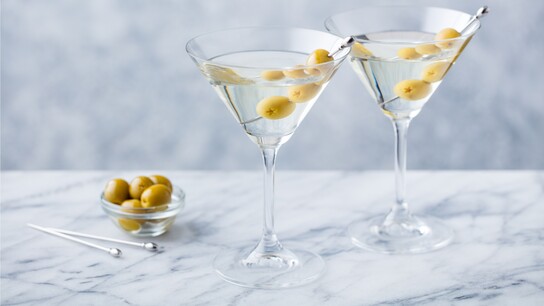
Few cocktails are as engaging as the Martini. The drink has set bartenders on fire when they are asked to shake when they prefer to stir, and has inspired entire books dedicated solely to this drink. What is the thing about the Martini?
History
The Martini originated from a trend around the mid-19th century and early 20th century to mix Genever (a Dutch and slightly fattier juniper spirit) or Gin with Vermouth (a wine flavoured with wormwood), cocktail bitters, Curaçao (orange liqueur), and sugar syrup. Eventually, Genever was replaced by Old Tom Gin (a sweet gin), and eventually dry Gin, and sweet Vermouth with dry Vermouth, while sugar syrup and Curaçao disappeared. In other words, the drink became less sweet and less citrusy. Bitters remained a popular ingredient until the 1940s and are making a comeback today.
Dry Martini75 ml Dry Gin 15 ml Extra Dry White Vermouth Olive/Lemon Zest
|
Martini today
Today we know the Martini best as the Dry Martini. At its most conservative, these are drinks consisting only of dry Gin and extra dry Vermouth, shaken or stirred with ice, served (without ice) in a martini glass and garnished with a twisted lemon peel or olive.
Slight variations in preparation method and garnish have given rise to drinks with their own names. Here are some examples:
- Bradford (shaken)
- Dickens (no garnish)
- Dirty Martini (olive and a bar spoon of olive brine)
- Franklin (two olives)
- Gibson (two cocktail onions)
A number of larger variations have also emerged over time. They usually reflect trends in the world of spirits in general. During the 20th century, for example, Vodka became an extremely popular spirit, giving rise to the Vodka Martini, where Gin has been replaced by Vodka. Today's interest in bitters has led to these making their way back into Dry Martinis. And in the 1920s and 30s, various liqueurs and fortified wines were added to the drink, resulting in, among others, James Bond's Vesper, which was made with Gin, Vodka and Kina Lillet, which was an aromatized wine, but not a Vermouth, since it did not contain wormwood, which is required in Vermouth (instead, it contained China bark, which, like wormwood, gives bitterness).
In recent times, modern variations such as the Espresso-Martini and Appletini have emerged, and the term Martini is changing its meaning.
So what exactly is this cocktail?
So what exactly is the Martini, this mysterious drink that moves through time, changing ingredients but keeping the same name?
At its most general, with cocktails like Espresso-Martini and Appletini, where the drink tastes of anything but juniper berry liquour and Vermouth, the term is watered down to include virtually anything served in a Martini glass or similar.
More specifically, a Martini is a drink that purifies the flavours of spirits, Vermouth (or similar) and any liqueurs and bitters and is served ice-cold, but without ice, in a Martini glass or similar. This would therefore also include the Vodka Martini. But the combination of this type of ingredients existed long before the Martini was conceived and includes drinks that have their own names and that appeared long before Martini was even mentioned. The Manhattan, made of Whiskey, Vermouth and cocktail bitters, is a good example. It is therefore regrettable that the inventor of the Vodka Martini did not have a better imagination than to call the drink exactly this.
At its most conservative, the drink is a mixture of clear juniper berry spirit and Vermouth (or similar), optionally with bitters and perhaps a little Curaçao, served ice-cold, but without ice, in a Martini glass or similar. Sometimes it is shaken, but mostly it is stirred. Sometimes it is garnished with olives, other times with lemon twists or cocktail onions.
How to make a perfect classic Martini
A classic Martini is at its best a seductive, yet strong, cocktail that refines and balances the flavours of juniper berry spirit and Vermouth or similar. Here's how to get it perfect:
Ingredients
Since classic Martinis mainly consist of two ingredients, the taste and character of these also come through clearly. The type of juniper spirit and aromatized wine can therefore be decisive for how the taste will be. Whether you use London, Dry or Old Tom Gin; Junge or Oude Genever; dry or sweet, white, pink or red Vermouth, the most important thing is that you choose ingredients that you and your guests like and that work well together. London and Dry give the lightest and driest expressions; Old Tom the sweetest; Oude Genever the boldest; and Jonge Genever a middle ground.
The amount of Vermouth
How much Vermouth should be in a Martini depends on preference. "Wet" contains a lot of Vermouth, while the discussion is heated about how much Vermouth should be in drier versions. A classic Dry Martini can contain anything from 1 part Vermouth and 5 parts gin to almost no Vermouth. Some bartenders are content to pour a little Vermouth directly into the glass and then pour it out and add the remaining components. Others pour Vermouth over the ice in the mixing glass or shaker to drain off the liquid before adding the gin. The most extreme are content to spray a small layer over the drink before serving. In any case, this is a question of preference, so ask yourself and your guests what is preferred.
Bitter and Curaçao
Traditionally, many Martinis were made with these ingredients, and there is currently a renaissance for bitters that is also influencing how today's Martinis are made. Curaçao is rarely used, but is not incorrect, considering the drink's history.
Temperature
Since all the main ingredients in the Martini contain (quite a lot of) alcohol, it is also a strong drink. It is therefore important that the drink is served at a low temperature, which reduces the alcohol bite and makes the drink appear fresher. Serve the drink in a frozen glass or in a glass chilled with ice cubes and water. If necessary, freeze/chill the stirring cup as well. Some people even chill the Vermouth in the refrigerator and the Gin in the freezer, but this reduces the amount of water released from the ice during shaking or stirring and therefore gives a more concentrated expression.
Shaken or stirred?
The big question, of course, is whether to shake or stir Martinis. Basically, drinks that consist only of clear ingredients should be stirred to preserve the clarity of the drink. A shaken Martini becomes somewhat more hazy and cloudy due to small amounts of air being shaken into the drink. But the small air bubbles also affect the texture of the drink, so ultimately it is a question of preference and the degree to which one emphasizes appearance. The most extreme choose not to use ice at all, but Vermouth from the refrigerator and Gin from the freezer.