


LEARN ABOUT COCKTAILS
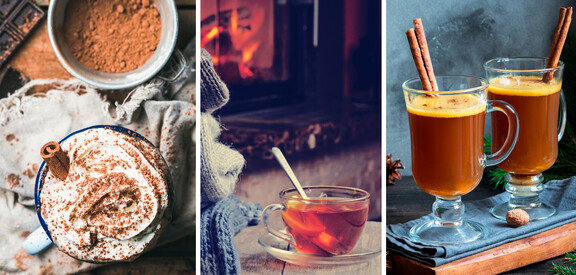
Why are hot drinks so popular?
Hot drinks are perhaps some of the oldest drinks we have. While ice cubes and cold cocktails only became popular with the advent of rapid ice transport and artificial freezing, hot drinks have been with us for as long as alcohol and fire. Not surprisingly, it is particularly in cold regions that many well-known hot drinks originated: In the snow-covered Austrian Alps, tea and Inländerrum are mixed to make Jägertee; in windy parts of Great Britain, hot water, honey, lemon and cloves are mixed with Scotch whisky to make hot scotch toddy; and in other parts of the world, wine and spices are used to make mulled wine. Irish coffee is enjoyed all over the world, but is said to have originated during a winter storm at a seaplane harbour in Ireland (see separate box).
|
The history of Irish Coffee: There are many variations on the story, but several sources suggest that the drink was developed at Foynes Seaplane Harbour on the west coast of Ireland around 1940. At that time, this was a natural landing point for transatlantic flights due to their limited range. In the winter of 1943, a plane bound for New York had to return due to weather conditions, and the cook, Joe Sheridan, was asked to make something to warm up the passengers. He added a dash of Irish whiskey to the coffee, and one of the passengers is said to have thanked Joe for the coffee and asked if it was Brazilian. Joe is said to have replied with a smile: “No, it's Irish Coffee” (Source: Foynes Flying Boat and Maritime Museum).
|
Hot drinks are easy to make. Forget shakers, muddlers, strainers, stirrers, ice cubes, fancy glasses, straws, rare tropical fruits and dozens of types of spirits. All you need are ordinary kitchen utensils, common food and beverages, and some source of alcohol such as red wine or brown spirit.
Two types of hot drinks
Broadly speaking, hot drinks can be divided into two types: those containing coffee or cocoa, and those containing other hot beverages such as tea, apple juice, wine, water, or similar.
Two basic recipes for hot drinks |
|
| Hot drink without coffee/cocoa | Hot drink with coffee/cocoa |
| Approx. 6 cl. barrel-aged spirits (whisky, rum, brandy, etc.) | Approx. 6 cl. barrel-aged spirits (whisky, rum, brandy, etc.) |
| 1-2 tsp. sugar/honey | 1-2 tsp. sugar/brown sugar |
| Cinnamon/cloves/star anise, etc. for infusion | Coffee/cocoa |
| Hot - Tea/apple juice/wine/water | Whipped cream for topping |
| Optional: lemon/lime |
Cinnamon/cocoa powder/grated chocolate for topping |
In both of these types, and in most hot drinks, barrel-aged spirits with a bit of character are used. This complements the strong flavours of spices, coffee and cocoa well and means that the spirits not only add alcohol, but also flavour and complexity to the drink. If mulled wine is used, as in gløgg, the amount of spirit can be reduced, omitted or replaced with fortified wine such as Port wine for red wine or Sherry and Madeira wine for white wine. The main difference between the two types is that coffee and cocoa have a stronger flavour than, for example, tea and do not need the “help” of spices to balance the spirit. Therefore, coffee and cocoa drinks are generally not flavoured with spices beyond a sprinkling of cinnamon, cocoa or grated chocolate on top of the cream, while hot drinks made with tea, apple juice, wine or water are usually flavoured with spices to add extra character to the alcohol. Coffee and cocoa often need to be softened, and are therefore often topped with lightly whipped cream. Lemon and lime are not used in these drinks, because the acid can cause the cream to separate. In other drinks, lemon/lime can add extra freshness.
Tips
Here are some useful tips:
- Use heat-resistant cups for serving.
- Do not heat the spirits, as the alcohol evaporates easily and the spirits lose much of their character. Instead, add warm ingredients to the spirits.
- Place spices that are small enough to easily fit in the mouth in a tea strainer or similar; larger spices such as star anise, cinnamon sticks and the like can be served in the cup as a garnish.
- Taste as you go along, considering sweetness and any acidity.
- When using whipped cream, pour it carefully over the drink using a teaspoon as a base so that it floats nicely on top.